
Avipel Grower’s Guide
Bird Damage to Corn Seed: Why Your Stand Is Thin — and How to Stop It
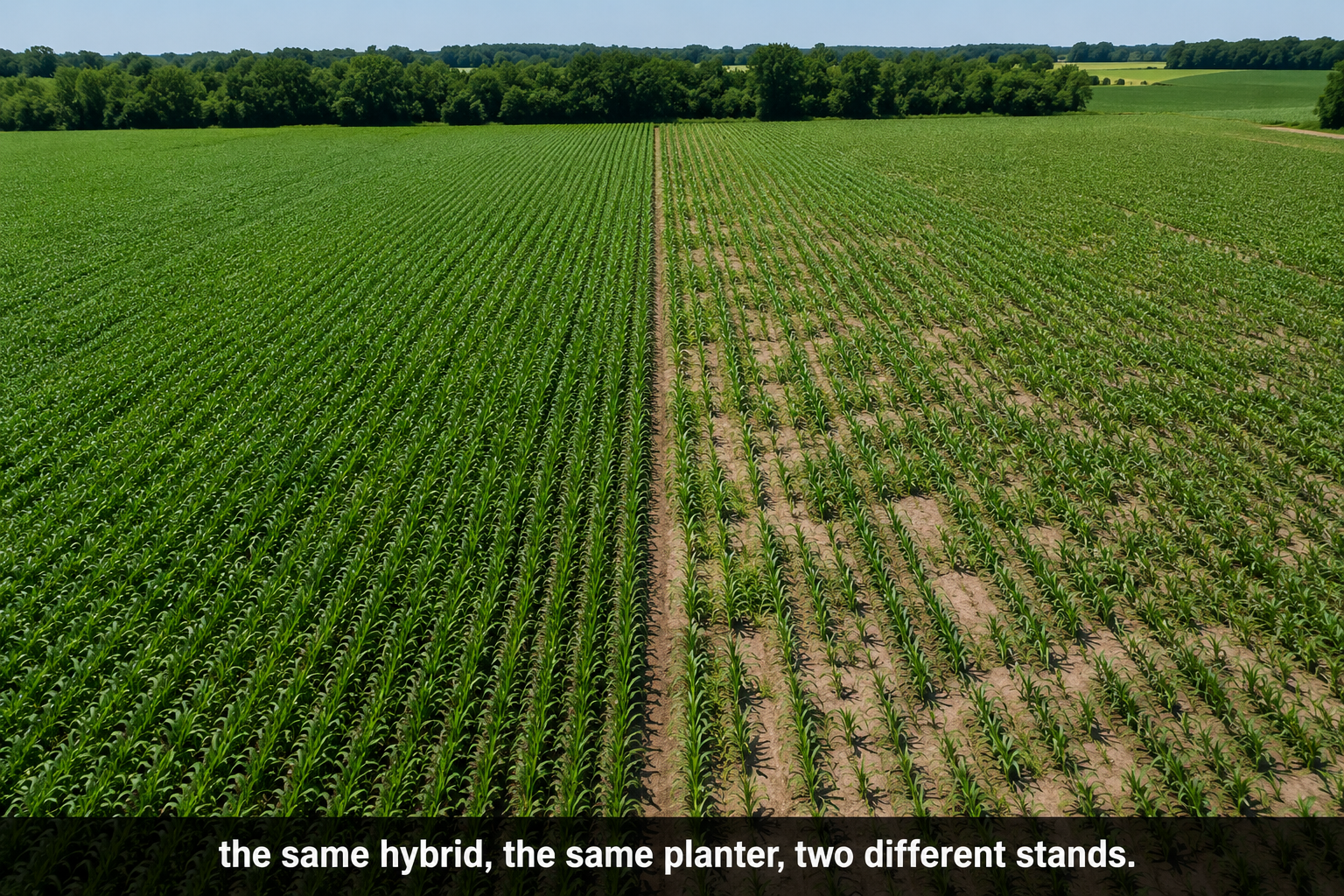
Skips here. A short stretch of bare row there.
A few spots where the corn just didn’t come up. You’ve already checked the obvious suspects — the planter, the seed, the soil temperature the week you ran. Nothing quite explains it.
Here’s a cause most growers never check: birds pulling corn seed out of the row before it ever emerged. It’s easy to miss because there’s nothing green to see when it happens. The damage starts the day the planter drops the seed and it’s mostly finished before V2 — and a spring rain can wash away the evidence within 48 hours. So the gaps show up weeks later as a thin, uneven stand, and the bird that caused it is long gone. This page is here to help you do one thing: figure out whether birds are quietly costing you yield, and — if they are — what to do about it.
We’ll walk through which birds pull corn seed, how to read the damage in your own field, how to tell it apart from cutworm or a planter problem, what it actually costs per acre, and the proven, nonlethal way to stop it.
A few facts worth sitting with
Birds have been documented destroying more than one million acres of field and sweet corn across the United States every year, before the crop can even emerge (USDA-cited industry figure).
Identify your bird
Which birds damage corn — and how to tell them apart
Several common species eat planted corn seed, and they tend to hit at different stages. Knowing which birds are working your field helps you predict the pattern of damage and the timing.
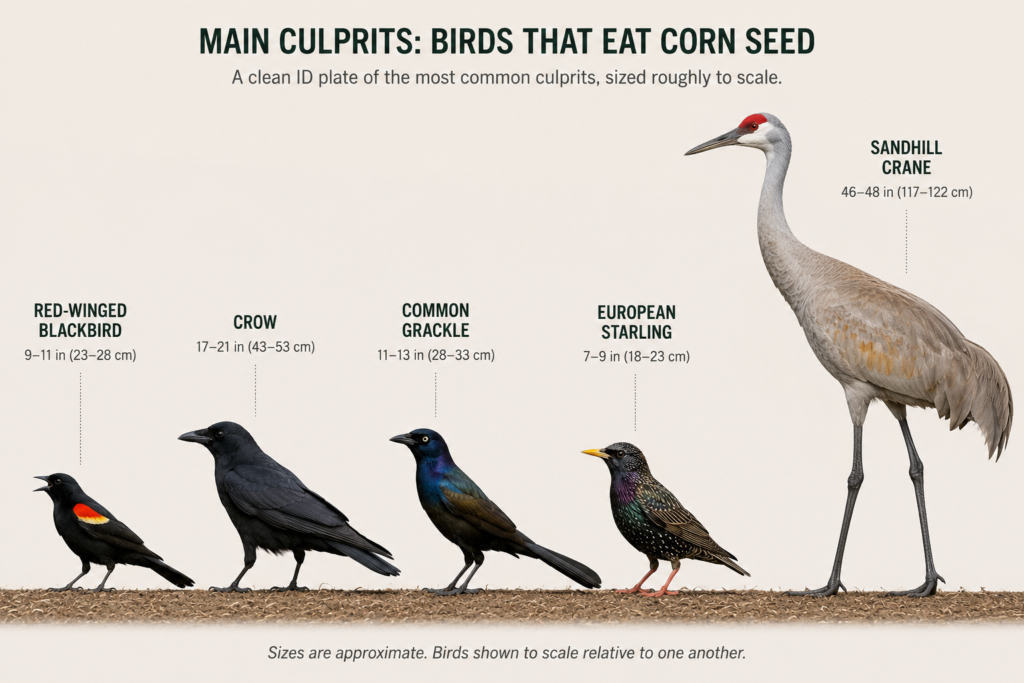
The birds most often responsible for bird damage to corn seed:
- Blackbirds (including red-winged blackbirds). Flock feeders. They work freshly planted fields hard and return to the same fields. Red-winged blackbird corn damage is among the most widespread across the Corn Belt.
- Crows. Smart, persistent, and willing to dig. Crows will follow a row and pull seed and young seedlings.
- Common grackles and boat-tailed grackles. Flock in numbers and target seed and emerging shoots.
- European starlings. Often hit in large mixed flocks, especially near livestock operations and edges.
- Sandhill cranes. The most efficient and the most damaging per bird. Cranes peck seed out of the row with surgical precision (more on their behavior below). Crane pressure concentrates in Wisconsin, Michigan, Indiana, Nebraska, South Dakota, and Minnesota.
- Pheasants (including ring-necked pheasants) and turkeys. Ground feeders that scratch and pull seed, often near cover.
- Geese. Graze emerging corn and pull seedlings, particularly near water.
Priority species
Sandhill cranes deserve a closer look because they’re so methodical about it.
- Peck the seed straight out of the ground after planting, working the soil with their bills.
- Understand row spacing — they know where the seed sits along a row and follow it.
- Mimic the look of cutworm or slug damage — the young plant gets laid down in the row with the root ball and kernel gone, which is exactly what sends growers down the wrong diagnostic path.
That overlap — crane damage that looks like insect damage — is one reason bird depredation goes undiagnosed. We’ll separate the two in the identification and bird-vs-cutworm sections below.
Timing tells you a lot, too. Blackbirds, grackles, and starlings work freshly planted fields in flocks and keep coming back to the same ground, so their damage shows up early and repeats. Sandhill cranes concentrate during spring migration as they move from the southern states north to breed; they’re monogamous and pair off, and a pair works a field methodically day after day. Geese and turkeys tend to be local and tied to nearby water or cover.
The practical takeaway: if your fields sit on a flyway or near a wetland, the pressure isn’t random; it lines up with the calendar and the landscape, and it returns season after season. That’s exactly why prevention beats reacting.
How to identify bird damage in your field
You confirm bird damage by reading the row, not by catching the bird in the act. Birds feed and leave; the evidence they leave behind is specific enough to diagnose if you know what to look for. The catch is timing — spring rain can erase the soil tells within a day or two, so the sooner you walk a suspect field after you notice a problem, the better.
Walk the field two to three weeks after planting and look for these forensic tells:
- Probe holes and disturbed soil along the row. Small, neat holes where a bill went in after the seed. Often in a line, because the bird followed the row.
- The corn seed missing from the row entirely. You dig where a plant should be and there’s nothing — no kernel, no sprout.
- The seed was pulled and eaten. Partial kernels or kernel fragments. Seed that was worked over but not fully carried off.
- Young plants laid down in the row with the root ball gone. The seedling came up, the bird pulled it, and what’s left is a wilted plant lying in the row with the seed end missing. This is the one that looks like cutworm.
- Damage concentrated at field edges and near wetlands. Bird damage is rarely uniform across a field. It clusters along tree lines, fencerows, grass waterways, and the wet corners — the places birds stage and loaf. A gappy edge with a clean field center is a strong bird signal.
- A low stand count that doesn’t match your seed drop. If your monitor said you singulated cleanly at 34,000 and your stand counts come in well under that with no planter explanation, something removed plants after the drop.
A simple way to put a number on it: run stand counts. In 30-inch rows, 1/1,000th of an acre is 17 feet 5 inches of row. Count the plants in that length in several representative spots (and a few edge spots), multiply by 1,000, and compare to your target population. If the edges are dragging the average down and you’re finding probe holes and missing kernels, you’re likely looking at bird damage — not a planter or seed issue.
Why the clock matters.
The reason bird damage so often goes uncounted is that the clearest evidence — the probe holes and disturbed soil — is fragile. A single hard spring rain can smooth the row back over within 48 hours, leaving only the gap weeks later when you finally walk the stand. By then the soil tells are gone and the bird is long gone with them, so the loss reads as a mystery. If you suspect birds, get into the field while the ground still shows what happened. A few photos on your phone of probe holes and missing kernels, dated, make the diagnosis a lot easier to confirm later — and a lot easier to act on before next planting
Having a firm grasp on this information will help you set and manage your expectations as well as reveal whether your crop yield potential matches your actual production.
Bird damage vs. what it usually gets blamed on
Most thin stands get blamed on the planter, the seed, or the soil — when the cause is birds. Before you can fix bird damage, you have to rule out the look-alikes. Here’s how bird depredation compares to the usual suspects.
| What you see | If it’s birds | If it’s something else |
|---|---|---|
| Skips and gaps in rows | Clustered at edges/near wetlands; probe holes; seed missing entirely | Planter/singulation issues are usually consistent across the whole field, tied to one row unit or meter |
| Plant laid down, root ball gone | Kernel and root end gone; often near field edges; probe holes nearby | Cutworm: plant cut/notched at or near the soil line, kernel still present; larvae found in soil nearby |
| Corn not emerging in spots | Seed physically removed when you dig; no sprout, no kernel | Soil crusting / cold soil: seed or sprout still present but stalled below the crust |
| Low corn stand count overall | Doesn’t match a clean seed drop; edges worst | Seed quality / depth: poor germination shows in seed tests; depth issues tie to planter setup |
| Down-pressure / depth symptoms | Not the cause — seed is gone, not buried wrong | Planter setup: uneven depth, sidewall compaction, open seed trench |
The cutworm mix-up is the costly one. Sandhill cranes lay a seedling down in the row with the root ball missing — and that looks almost exactly like a cutworm cut. The difference: cutworm leaves the kernel and cuts the stem; a bird takes the kernel and the root end. Dig at the base. If the seed is gone, suspect birds. If you find a notched stem and a larva, suspect cutworm.
If you’ve ruled out the planter, the seed, and the soil and you’re still short plants — especially along the edges — it’s time to look at what birds cost you, and what prevention is worth.
What bird damage actually costs you per acre
The cost of bird damage is the value of the stand you lost — and it’s almost always more than the price of preventing it. There’s no single national number for what bird damage costs per acre, because it depends on bird pressure, your seeding rate, your yield, and the price of corn. So instead of handing you a made-up figure, here’s the math — laid out so you can run it on your own field. Then we’ve embedded the calculator so you can do exactly that.
Run your own numbers
Quick estimate using the standard yield-component method. For the full Avipel comparison — and to save your results — run the complete calculator.
The calculator above estimates your yield from your own ear counts and price per bushel, and shows what protecting the stand from bird loss is worth on your acres. It’s the most honest ROI tool we can give you — your field, your numbers. (It’s also where a lot of growers first put a dollar figure on a problem they’d been writing off as “just a bad corner.”)
The math behind it (an estimate — use your own inputs)
This is an illustration, not a guarantee. The figures are clearly labeled assumptions; swap in yours.
Assumptions (sources noted — update to current):
- Seeding rate: 34,000 seeds/acre (typical Corn Belt range is ~30,000–36,000; land-grant extension).
- Corn price: $4.50/bushel (label as current — check USDA NASS / CME for today’s price).
- Yield baseline: ~177 bu/acre (recent U.S. average; USDA NASS).
- Corn seed cost: ~$3.50–$4.50 per 1,000 seeds (varies by hybrid/trait).
Step 1 — the seed you already paid for and lost. Say birds pull a modest 8% of your planted seed in a pressured field: 34,000 × 8% ≈ 2,720 seeds/acre gone. At $4.00 per 1,000 seeds, that’s about $11/acre in seed cost alone — money spent on plants you’ll never harvest.
Step 2 — the bigger number: the lost yield. Seed cost is the small part. The real loss is the grain those missing plants would have made. The size of that loss tracks with how much of your stand bird pressure takes:
- A 5% yield reduction on a 177 bu/acre field ≈ 8.9 bu/acre × $4.50 ≈ $40/acre.
- Under heavy, documented crane pressure, the gap is far larger. In an independent 2025 field study, treated fields yielded 23.5% more than untreated fields at the highest crane pressure (see the proof). On the same field, that’s ~42 bu/acre — over $185/acre at $4.50.
So the defensible range is wide and honest: from roughly $11/acre in sunk seed alone in a lightly pressured field, up to well over $150/acre in lost yield where bird and crane pressure is heavy. Your field sits somewhere on that line, and the calculator tells you where.
Prevention vs. replant — the comparison that matters
| What it costs | What you get | |
|---|---|---|
| Do nothing | The lost-yield figure above ($40–$185+/acre under pressure) | A thinner stand, every season the birds return |
| Replant | Seed + fuel + labor + lost calendar days; often a yield penalty for late planting | A second stand — if the calendar allows, which in short-season ground it often doesn’t |
| Treat the seed (prevention) | A few dollars per acre (ask your retailer for current pricing) | Protection of the stand you planted, through emergence |
Replanting is the expensive surprise. By the time you know the stand failed, the planting window may have closed — and in short-season regions, replanting corn often isn’t viable at all. Worse, if birds caused the first failure, they’ll work the replant too. Prevention is the only one of the three that gets ahead of the problem instead of reacting to it.
Why The Old Fix Is Gone
Growers used to lean on organophosphate seed treatments to keep birds off planted corn — and those are gone. The old products worked one of two ways: they tasted bad enough to deter birds, or, at higher exposure, they could kill them. Either way, they came off the market. That left a real gap: a genuine bird problem with no registered, purpose-built tool to address it.
That gap is why so many growers today are stuck managing bird damage with workarounds — scare tactics, mismatched repellents, or simply absorbing the loss as a cost of farming near a wetland. None of those protect the seed itself, where the damage actually happens.
What was needed was a tool that did three things the old chemistry couldn’t:
- Protect the seed nonlethally (no dead birds, no toxicity concerns)
- Stay put in the soil without leaching
- Hold up through emergence
That’s the bar the modern fix had to clear.
Most “bird repellent” options aren’t built for planted seed. When growers search for a bird repellent, what usually comes up is gear aimed at standing crops or open ground — propane cannons, reflective tape, distress-call units, kites and balloons, broadcast sprays. Those have their place for some birds and some situations, but they share a blind spot: they try to scare birds off a field, and birds habituate to scares fast. None of them protect the kernel itself, sitting an inch down in the row, which is where bird damage to corn seed actually happens.
A seed-applied repellent is a different approach to the same parent problem: instead of guarding the whole field, you make the one thing the bird is after — the seed — not worth eating. That’s the lane Avipel was built for.
The proven fix
The proven, nonlethal solution: bird-repellent seed treatment
Avipel is a scientifically proven, nonlethal bird repellent seed treatment that stops birds from eating newly planted corn seed. It’s a liquid that coats each kernel before it goes in the ground. It doesn’t kill a single bird — and that’s by design.
Here’s how it works, plainly:
- You treat the seed with Avipel before planting. Every kernel gets a uniform protective coating.
- A bird finds the seed and eats it — and gets immediate but temporary digestive distress. Not lethal. Just unpleasant enough.
- The bird quickly learns that your seed isn’t worth the trouble and looks elsewhere for food.
- Your seed stays in the ground, emerges, and gives you the uniform stand you planted for.
That “leaves elsewhere” step is the whole mechanism. Avipel works by teaching, not killing.
The birds move on to natural food sources, your stand comes in even, and nothing in your field gets poisoned.
This is the answer to the problem the last few sections built: the invisible loss (birds pull seed before V2), the misdiagnosis (it looks like cutworm or a planter issue), the cost (a thinned stand or a replant you can’t afford), and the missing tool (organophosphates are gone). A nonlethal bird repellent seed treatment closes all four at once.
The next two sections are for the skeptics, and we mean that as a compliment. If you want to know why it works and whether the proof holds up, keep reading.
The science
The science: AQ (9,10-anthraquinone)
Avipel’s active ingredient is 9,10-anthraquinone — “AQ” for short — a plant-derived compound that repels birds without harming them. AQ isn’t a synthetic novelty. It occurs naturally in a number of plants, including aloe vera, rhubarb, greater plantains, and sennas. It’s the reason Avipel can be both effective and nonlethal.
A few terms, defined once and then used plainly:
- AQ is a biopesticide — a pesticide derived from natural materials, registered for use as a corn seed treatment. (A biopesticide bird repellent is a different category from the old organophosphate chemistry.)
- AQ is nonsystemic. It stays as a coating on the seed; it doesn’t move up into the plant tissue you harvest.
- AQ is nonlethal to birds. It causes temporary digestive discomfort — a learned avoidance, not a kill.
For growers balancing crops, livestock, land, and groundwater, AQ’s environmental profile is the part worth knowing:
- UV-stable — it holds up to sunlight rather than breaking down on contact.
- Biodegrades with a roughly 28-day half-life in soil — it does its job during the vulnerable window and then breaks down.
- Very low soil mobility — it stays where it’s applied instead of moving toward groundwater.
- Insoluble in water — which minimizes the risk of it washing into your well or aquifer.
Put together: AQ protects the seed during the exact window birds attack it, then degrades. It doesn’t accumulate, it doesn’t move, and it doesn’t poison. That combination — effective, plant-derived, nonlethal, and environmentally well-behaved — is what makes it the differentiator. Read more on how Avipel works.
Independent, third-party proof
The proof: an independent 2,200-acre field study
The strongest evidence for Avipel doesn’t come from Avipel — it comes from the International Crane Foundation. In 2025, the International Crane Foundation (ICF) published Year 2 of an independent field study measuring how well Avipel protects germinating and emerging corn from sandhill cranes across real working farms in Wisconsin. This is the kind of proof a skeptical grower should want: third-party, recent, controlled, and measured by drone rather than by eye.
The scale (2025 season):
- 2,219.7 acres across 57 fields and 9 participating farmers — 34 treated fields and 25 untreated control fields.
- Corn stands measured by UAV (drone) imagery with stand-count software once the corn passed the four-leaf stage and was no longer vulnerable to cranes.
- Drone-estimated plant spacing matched hand measurements almost exactly (Pearson r = 0.969).
- The study roughly doubled in scope from Year 1 (2024), and builds on peer-reviewed crane research (Barzen et al. 2018; Lacy et al. 2018; Wise 2018).
What they found:
- More than 25% more corn plants per acre with Avipel. Untreated fields averaged fewer than 23,000 plants/acre; Avipel-treated fields averaged more than 29,000 plants/acre.
- A 23.5% yield increase at the highest crane pressure. Where sandhill crane abundance was heaviest, treated fields out-yielded untreated fields by 23.5%.
- Avipel was the single most influential factor protecting the stand — the strongest predictor of plant population in the study’s model, even after accounting for soil type, slope, distance to wetlands, distance to roads, and crane density. The result was highly statistically significant (p < 0.001).
- The protective gap grows as crane pressure rises. Crane abundance pulled untreated stands down; Avipel directly reduced that impact — so the more cranes, the bigger the difference treatment made.
Stated honestly: Avipel is highly effective at limiting crane damage to cornfields at scale when applied correctly — uniform coverage matters. Even treated fields can see a modest residual impact at very high crane density, likely flocks testing seed. Avipel dramatically reduces crane damage; it doesn’t claim to zero it out under extreme pressure. That honesty is the point — it’s what makes the >25% and 23.5% figures believable.
Alongside the ICF work, Avipel’s evidence base includes USDA field studies, more than a decade of research and development by Arkion Life Sciences, Michigan State University crane research, and the foundational peer-reviewed crane-deterrent studies (Lacy et al. 2018; Barzen et al. 2018). Full citations are covered above.
How to use Avipel
Avipel is applied to the seed before planting — and one application protects the seed through emergence. It’s built to fit how you already work, not to add a step in the field.
The basics:
- Liquid application: the standard rate is 13.5 fluid ounces of Avipel per hundredweight (cwt) of corn seed (by weight, 16.5 oz/cwt). One gallon treats roughly 980 pounds of seed. The liquid is easy to apply and lets you treat seed ahead of the busy planting season so you’re ready when conditions are.
- Dry (hopper box) application: 2.0 ounces (one scoop) per 25 pounds of seed, mixed in the planter box just before planting. Add Avipel and mix thoroughly before any talc or graphite.
- Uniform coverage is the one thing that matters most. Efficacy depends on every kernel getting enough active ingredient — the ICF study’s “when applied correctly” caveat comes down to this. Calibrate, agitate, and check coverage.
- Field corn and sweet corn both. Avipel is labeled for both.
- One pass, full window. A single application protects the seed around the clock, through emergence — the exact period birds attack it.
A regulatory note: Avipel is an SLN 24(c) registered product, which means it’s approved for use under individual state authority. Use it only in accordance with your state’s registration and always follow the label. Check your state’s status before you plan to treat.
For step-by-step directions, see the product labels and application guides and how Avipel works.
Who this is for
Avipel is for any corn grower losing stand to birds, and for the advisors and retailers who help them protect it. If your fields sit near wetlands, tree lines, or a flyway, or if you’ve seen more cranes and blackbirds year over year, you’re the grower this is built for.
- Field-corn growers protecting a uniform stand and the yield that rides on it.
- Sweet-corn growers, where a thin or gappy stand hits both yield and pack-out quality.
- Growers in crane country — Wisconsin, Michigan, Indiana, Nebraska, South Dakota, Minnesota — where replanting often isn’t on the table and prevention is the only real play.
- Crop advisors and agronomists who diagnose thin stands and want a proven, nonlethal tool to recommend.
- Ag retailers and distributors whose growers keep asking how to stop birds from eating planted corn — a question that now has a registered answer worth stocking.
If you advise or supply growers and want to carry or recommend Avipel, talk to us — we’ll get you what you need.
Keep going
Where to get it and what to do next
You don’t have to decide everything today. Pick the next step that matches where you are.
The window that matters is the off-season, when you’re planning inputs — not the morning you find a thin stand. A grower who lines up bird protection before planting arrives at the season already ahead of the problem. See how Avipel works or start with the calculator.
FAQ
Frequently asked questions
What birds eat planted corn seed?
Blackbirds and red-winged blackbirds, crows, common and boat-tailed grackles, European starlings, sandhill cranes, pheasants, turkeys, and geese all eat newly planted corn seed or pull young seedlings. Sandhill cranes are the most efficient per bird — a single pair can pull up to 800 seeds a day.
Why is my corn stand thin if my planter checked out fine?
If singulation and depth were good and your stand still came in well under your seed drop — especially along field edges and near wetlands — birds may have pulled seed after planting. Dig where plants are missing: if the kernel is gone entirely, suspect bird damage rather than a planter or seed problem.
How do I tell bird damage from cutworm damage?
Both can leave a seedling laid down in the row. The difference is at the base: cutworm cuts or notches the stem near the soil line and leaves the kernel; a bird takes the kernel and the root end. Find a notched stem and a larva, it’s cutworm. Find a missing seed and probe holes, it’s birds.
How do I stop birds from eating my planted corn seed?
Treat the seed before planting with a registered bird repellent seed treatment. Avipel coats each kernel so birds get temporary digestive distress and leave the seed alone — nonlethal, and effective through emergence.
Is Avipel safe? Does it kill birds?
No — Avipel is nonlethal. It causes temporary digestive discomfort that teaches birds to avoid the seed. Its active ingredient, AQ, is nonsystemic to corn, doesn’t harm fish or aquatic and terrestrial plants at labeled use, and has very low soil mobility, so it won’t contaminate groundwater.
When should I treat corn seed for birds?
Before planting. The liquid formulation lets you treat seed ahead of the planting rush, so protection is on the kernel from the moment it goes in the ground — the start of the vulnerable window.
Reference
Glossary: key terms
The core terms used on this page, in plain language.
- 9,10-anthraquinone (AQ)
- The plant-derived active ingredient in Avipel. It gives a bird temporary, harmless digestive discomfort so it learns to leave treated seed alone. Occurs naturally in plants such as aloe vera, rhubarb, and sennas.
- Biopesticide
- A pesticide derived from natural materials rather than synthetic chemistry. AQ is registered as a biopesticide corn seed treatment — a different category from the old organophosphate chemistry.
- Bird damage to corn seed (seed depredation)
- The loss of planted corn seed and young seedlings to birds in the window between planting and emergence — before the plants are ever counted, which is why the cause is so often missed.
- Cutworm
- A soil-dwelling larva that cuts corn seedlings at or near the soil line. Its damage mimics crane damage — the tell: cutworm cuts the stem and leaves the kernel; a bird takes the kernel and the root end.
- Emergence (V2)
- The stage when the corn seedling breaks the soil surface. Bird damage happens mostly between planting and emergence, and is usually finished by about the V2 (two-leaf) stage.
- Flyway / migration corridor
- The seasonal routes migratory birds such as sandhill cranes follow. Fields on a flyway see predictable, recurring bird pressure that lines up with the calendar and the landscape.
- Habituation
- The way birds quickly learn a scare device — cannon, reflective tape, distress call — is harmless and return to the field. It’s why scare tactics fade within days.
- Nonlethal
- Deters birds without killing them. Avipel teaches avoidance through temporary discomfort rather than toxicity — no dead birds, no poisoned field.
- Nonsystemic
- Stays as a coating on the seed; it does not move up into the plant tissue you harvest.
- Organophosphate
- The older class of seed-treatment chemistry once used to keep birds off planted corn, now off the market — leaving the gap that a nonlethal seed treatment fills.
- Probe holes
- Small, neat holes left in the row where a bird’s bill went in after the seed — often in a line, because the bird followed the row. A primary forensic sign of bird damage.
- Seed treatment (seed-applied repellent)
- A product applied directly to the seed before planting. Instead of guarding the whole field, it protects the kernel itself — the one thing every bird on the list is after.
- Singulation
- How evenly a planter drops one seed at a time. Clean singulation with a still-thin stand points away from the planter and toward something removing seed after the drop.
- SLN 24(c) registration
- A “Special Local Need” pesticide registration approved under individual state authority. Avipel is registered this way, so use follows your state’s registration and label.
- Stand / stand count
- The number of established plants per acre, and the method of measuring it. In 30-inch rows, 1/1,000 acre is 17 ft 5 in of row — count several spots, multiply by 1,000, and compare to your target. A count well under your seed drop signals a problem.
- Yield-component method
- A pre-harvest yield estimate built from harvestable ears, average kernel rows per ear, and average kernels per row — the method behind the calculator on this page.