
Avipel Grower’s Guide
Which Birds Damage Corn Fields? A Grower’s Guide to the Species Pulling Your Seed
If you’ve landed here, you’ve probably already ruled out the planter and the seed lot and started to suspect something is pulling corn seed out of your rows. The next question is the practical one: which birds damage corn fields — and which one is working yours?
It matters more than it sounds. The species tells you the timing (when to expect pressure), the pattern (edges, whole field, near water), and the fix that actually holds. A propane cannon that rattles a flock of blackbirds for a week does nothing to a pair of sandhill cranes methodically walking your rows at dawn. Knowing your bird is the first step to protecting your stand.
This guide breaks down the eight birds most often responsible for bird damage to corn seed, how each one feeds, when it hits, and where in the country it’s worst. It’s the deeper companion to our main page on bird damage to corn seed — start there if you want the full picture on identifying, costing, and preventing the problem.
Start here
The short answer: eight birds, two feeding styles
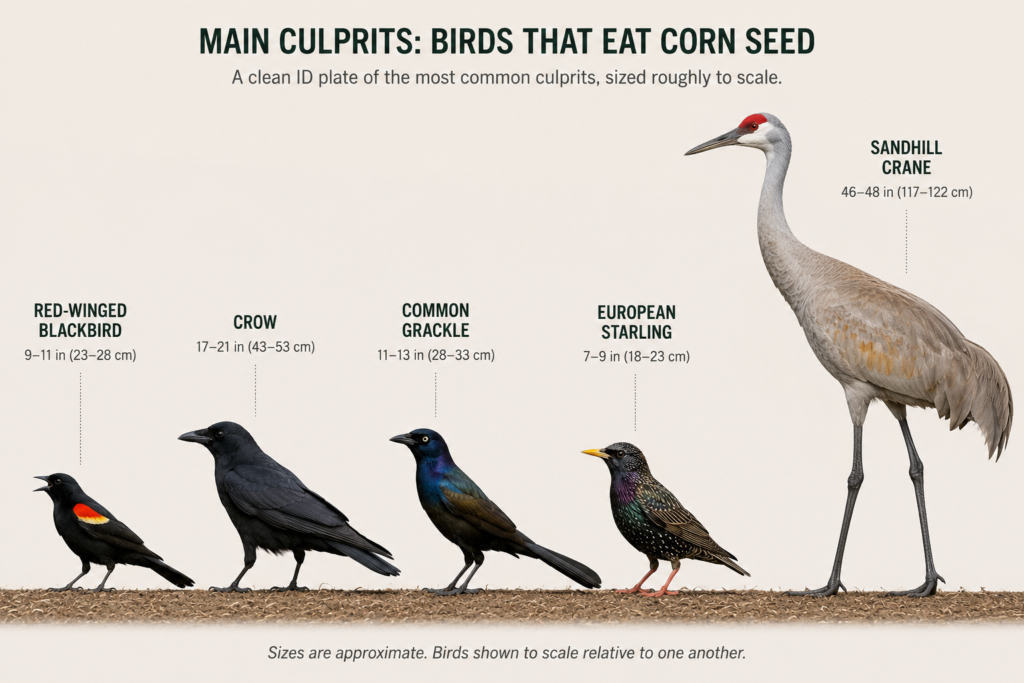
Nearly all bird damage to planted corn comes from eight species, and they fall into two behavioral camps. Get the camp right and you already understand most of what the bird will do to your field.
- Flock feeders — blackbirds, red-winged blackbirds, common and boat-tailed grackles, European starlings. They arrive in numbers, hit freshly planted fields hard, and return to the same ground day after day. Damage shows up early and repeats.
- Deliberate, high-impact feeders — sandhill cranes, crows. Fewer birds, far more damage per bird. They understand rows, dig for seed, and mimic insect damage in a way that sends growers down the wrong diagnostic path.
- Local ground feeders — pheasants, turkeys, geese. Tied to nearby cover or water. Often a secondary contributor rather than the main event, but real where their numbers are high.
Here’s the quick-reference version before we go bird by bird:
| Bird | Feeding style | When it hits hardest | Where it’s worst | Damage signature |
|---|---|---|---|---|
| Red-winged & other blackbirds | Large flocks, repeat visits | Right after planting, through emergence | Corn Belt-wide | Widespread seed loss, worst at edges |
| Crows | Smart, persistent, will dig | Planting through early seedling | Nationwide | Follows the row, pulls seed and seedlings |
| Grackles (common, boat-tailed) | Big mixed flocks | Planting and emergence | Corn Belt, Southeast | Seed and emerging shoots |
| European starlings | Large mixed flocks | Planting window | Nationwide, near livestock | Clustered seed loss near edges/operations |
| Sandhill cranes | Methodical pairs, surgical | Spring migration | WI, MI, IN, NE, SD, MN | Probe holes, seedling laid down, kernel gone |
| Pheasants (ring-necked) | Ground scratch-and-pull | Planting through seedling | Northern Plains, upper Midwest | Scratching near cover, pulled seed |
| Turkeys | Ground feeders, flocks | Emergence | Widespread | Pulled seedlings near woods/cover |
| Geese | Graze and pull | Emergence | Near water statewide | Grazed shoots, pulled seedlings near water |
Blackbirds and red-winged blackbirds: the widespread offenders
Red-winged blackbird corn damage is among the most common and widespread causes of stand loss across the Corn Belt. Blackbirds feed in large flocks, they favor freshly worked ground, and — the part that costs you — they come back to a field they’ve fed in successfully.
What that means in your field:
- Volume over precision. One blackbird takes a little; a flock working a field over several mornings takes a lot. The loss is cumulative, which is exactly why it gets written off as “a bad year” instead of a bird problem.
- Edge-weighted. Blackbirds stage in tree lines, fencerows, cattails, and grass waterways, then work outward. A field with a thin, gappy edge and a clean center is showing you a classic flock-feeder signature.
- Repeat pressure. Because they return, scare tactics fade fast — birds habituate to a cannon or a reflective tape within days. The damage keeps accruing after the scare stops working.
Blackbirds are the reason so many growers underestimate bird pressure: no single dramatic event, just a steady leak that adds up to a measurably thinner stand.
Crows: smart, persistent, and willing to dig
Crows are among the most deliberate seed-pullers in a cornfield. They’re intelligent, they’re persistent, and unlike a lot of birds they’ll actively dig to get at a kernel or a young seedling.
- They follow the row. Crows figure out where the seed sits and work along the line, which produces gaps in a pattern rather than random scatter.
- They take seed and seedlings both. A crow will pull a germinating kernel and a just-emerged plant, so their damage spans the whole planting-to-emergence window.
- They’re hard to scare off for long. Their intelligence is exactly why deterrence-by-fright fails: crows learn quickly that a stationary scare device is harmless.
Crows rarely hit in the overwhelming numbers a blackbird flock brings, but bird for bird they do more damage, and they keep at it.
Grackles: common and boat-tailed
Common grackles and boat-tailed grackles flock in numbers and target both seed and emerging shoots. Functionally they behave much like blackbirds — big flocks, freshly planted fields, repeat visits — and they often mix into the same flocks.
- Common grackles are widespread across the Corn Belt and into the Northeast.
- Boat-tailed grackles press the problem in the Southeast and along the Gulf and Atlantic coasts.
- Both work the seed row and clip emerging shoots, adding to the same edge-weighted, cumulative loss pattern the flock feeders create.
If you’re seeing blackbird-style damage, grackles are frequently part of the same picture.
European starlings: the mixed-flock multiplier
European starlings often hit in large mixed flocks, especially near livestock operations and field edges. Starlings are aggressive, abundant, and highly social, and they frequently travel with blackbirds and grackles — which is why a “blackbird problem” is often a blackbird-and-starling problem.
- Numbers. Starling flocks can be enormous, concentrating a lot of feeding pressure on a field in a short window.
- Proximity to feed and livestock. Fields near dairy and feedlot operations see extra starling pressure because the birds are already staging in the area for spilled feed.
- Edge and cluster damage. Like the other flock feeders, they leave the heaviest damage where they stage, so scout your edges and any field bordering a livestock yard.
Sandhill cranes: the most efficient bird per bird
Sandhill cranes cause the most damage per bird of any species on this list — and they’re the reason a lot of bird damage gets misdiagnosed as cutworm. Cranes don’t swarm a field like a blackbird flock. A monogamous pair works a field methodically, day after day, and a single pair can pull up to 800 corn seeds in a day (Barzen et al. 2018).
What makes cranes distinct:
- Surgical seed removal. Cranes peck the seed straight out of the ground, working the soil with their bills. They understand row spacing and follow the seed line.
- The cutworm look-alike. A crane will lay a young seedling down in the row with the root ball and kernel gone — which looks almost exactly like a cutworm cut. The tell: cutworm cuts the stem and leaves the kernel; a crane takes the kernel and the root end. Dig at the base to separate the two. We cover this in detail on how to identify bird damage in cornfields.
- Migration-timed. Crane pressure concentrates during spring migration as birds move north to breed, so it lines up with your planting window and returns on the calendar every year.
Crane pressure is heaviest in Wisconsin, Michigan, Indiana, Nebraska, South Dakota, and Minnesota — and because sandhill cranes are federally protected, lethal control isn’t an option in most situations, which makes nonlethal prevention the only real play. If cranes are your bird, see our focused guide to sandhill crane corn damage and the independent 2025 International Crane Foundation field study proving what a seed treatment does against them.
Pheasants, turkeys, and geese: the local ground feeders
Ring-necked pheasants, wild turkeys, and geese round out the list — usually as secondary contributors tied to nearby cover or water.
- Pheasants scratch and pull seed, working ground near grassy cover and shelterbelts. Strongest in the northern Plains and upper Midwest where pheasant populations are high.
- Turkeys are ground feeders that pull seedlings, often along woodland edges and near timber. Where turkey numbers are heavy, they’ll take emerging plants right off the row.
- Geese graze emerging corn and pull seedlings, particularly near ponds, rivers, and wet field corners. Their damage concentrates close to water and shows up as grazed-off shoots and pulled young plants.
None of these three usually drive the whole problem on their own, but on the right field — near a shelterbelt, a woodlot, or a pond — they add real losses on top of whatever the flock feeders and cranes are taking.
Field diagnosis
How to tell which bird is hitting your field
You identify the bird by reading the pattern, the timing, and the landscape — not by catching it in the act. Birds feed and leave; the field tells you who was there.
Use these three signals together:
-
The pattern of loss.
- Edge-weighted, cumulative, whole-field-ish: flock feeders — blackbirds, grackles, starlings.
- Following the row, seed and seedlings pulled, some digging: crows.
- Probe holes, seedlings laid flat with the kernel gone, cutworm look-alike: sandhill cranes.
- Scratching near cover; grazed shoots near water: pheasants, turkeys, geese.
-
The timing.
- Right after planting and repeating: flock feeders.
- Spring-migration window, methodical, pair-worked: cranes.
- At and after emergence, near cover or water: turkeys and geese.
- The landscape. Fields on a flyway, next to wetlands, tree lines, or livestock operations carry predictable, recurring pressure. The birds stage where the landscape lets them, so your worst damage lines up with your edges and your wet corners season after season.
Put those together and you can usually name your primary offender with confidence — and confirm it with a stand count and a walk of the rows.
The one thing they all want
Different birds, one place to stop them: the seed
Here’s the freeing part: you don’t have to solve eight birds. You have to protect one thing — the seed. Every species on this list is after the same target: the kernel sitting an inch or two down in the row, and the tender plant that comes out of it. Scare tactics try to guard the whole field and every bird habituates to them. A seed-applied repellent takes a different approach: it makes the one thing all of them want not worth eating.
That’s what Avipel does. Avipel is a scientifically proven, nonlethal bird repellent seed treatment whose active ingredient — 9,10-anthraquinone (AQ), a plant-derived compound — gives a bird temporary, harmless digestive distress the first time it eats a treated kernel. The bird learns the seed isn’t worth the trouble and moves on to natural food. No dead birds. No poisoned field. One application protects the seed through emergence — the exact window every one of these species attacks it.
It works the same way whether your bird is a flock of blackbirds or a pair of cranes, because it targets the shared behavior, not the individual species. See how Avipel works, or read the science behind AQ and the field proof on the main page.
Keep going
What to do next
FAQ
Frequently asked questions
Which birds damage corn fields the most?
Blackbirds and red-winged blackbirds cause the most widespread damage because they feed in large flocks and return to the same fields. Sandhill cranes cause the most damage per bird — a single pair can pull up to 800 seeds a day. Crows, grackles, starlings, pheasants, turkeys, and geese all contribute depending on your region and landscape.
What birds eat planted corn seed?
Blackbirds, red-winged blackbirds, crows, common and boat-tailed grackles, European starlings, sandhill cranes, ring-necked pheasants, wild turkeys, and geese all eat newly planted corn seed or pull young seedlings during the planting-to-emergence window.
How do I know if it’s blackbirds or sandhill cranes?
Blackbirds work in flocks, hit right after planting, and leave cumulative, edge-weighted damage. Sandhill cranes work as methodical pairs during spring migration, leave probe holes, and lay seedlings flat with the kernel gone — damage that looks like cutworm. Digging at the base to check for a missing kernel separates crane damage from insect damage.
Do crows really pull corn seed?
Yes. Crows are intelligent and persistent, they follow the seed row, and they’ll dig to reach a germinating kernel or pull a young seedling. Bird for bird they cause more damage than most flock feeders, though usually in smaller numbers.
Why do scare tactics stop working on these birds?
Because birds habituate. A propane cannon, reflective tape, or a distress-call unit rattles a flock for a few days, then the birds learn it’s harmless and come back. Deterrents that guard the whole field don’t protect the kernel itself, which is where the damage happens. A seed treatment that makes the kernel unpalatable is the approach birds can’t habituate around.
Will one seed treatment work against all these birds?
Yes. A bird-repellent seed treatment like Avipel protects the seed itself, so it works against any bird that eats the kernel or the emerging plant — blackbirds, crows, grackles, starlings, cranes, pheasants, turkeys, and geese alike. The active ingredient, AQ, causes temporary digestive discomfort that teaches birds to avoid the treated seed, nonlethally, through emergence.
Sources & references
- Barzen, J. A., A. P. Gossens, and A. E. Lacy. 2018. Sandhill crane foraging behavior and damage estimates in cornfields during spring. Proceedings of the North American Crane Workshop 14:67–80.
- Lacy, A. E., J. A. Barzen, and A. P. Gossens. 2018. Testing three chemicals for deterring crop damage by cranes. Proceedings of the North American Crane Workshop 14:81–88.
- USDA APHIS Wildlife Services — bird damage management in agriculture (industry-cited estimate: 1M+ acres of corn affected annually before emergence).
- Michigan State University — sandhill crane research.
- International Crane Foundation — Avipel-treated field studies (2024–2025), sandhill crane abundance and corn damage.
- Arkion Life Sciences, LLC — Avipel product labels and application guidance.
Avipel® and Arkion® are registered trademarks of Arkion Life Sciences, LLC, New Castle, DE. Avipel is an SLN 24(c) registered product; use only in accordance with individual state authority and the product label. Always read and follow label directions.