
The Real Cost of Bird Damage to Corn Per Acre
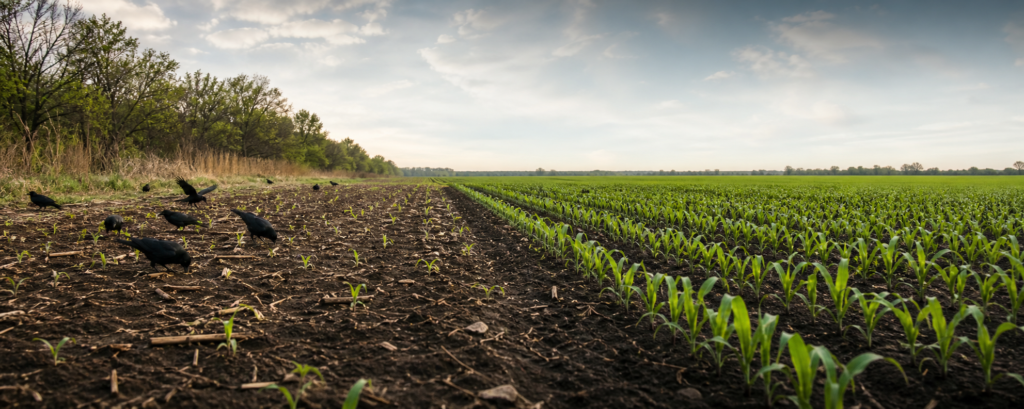
Bird damage is easy to under-price because you never see the invoice. There's no bill for the seed a crane pulls or the plants a blackbird flock takes — just a stand that came in a little short, a corner that "always runs rough," and a yield number at the end of the year that you chalk up to weather. The cost is real. It's just quiet.
This page makes it loud. The cost of bird damage per acre is the value of the stand you lost — and it's almost always more than the price of preventing it. There's no single national figure, because it depends on your bird pressure, seeding rate, yield, and the price of corn. So instead of a made-up number, we'll give you the math, the regional context, and the one comparison that actually drives the decision: prevention versus replant. Then you'll run it on your own field.
It's the economics companion to our main guide on bird damage to corn seed. To confirm birds are your problem first, see how to identify bird damage in cornfields.
Run the Corn Yield Calculator
Talk to an Avipel expert
Why there's no single "cost per acre" — and why that's honest
Anyone who hands you one flat national dollar figure for bird damage is guessing. The real number moves with four things:
- Bird pressure — a lightly pressured field and a field under heavy sandhill crane pressure aren't in the same universe.
- Your seeding rate — more seed in the ground means more to lose.
- Your yield potential — the grain each missing plant would have made is the biggest part of the loss.
- The price of corn — the same bushels lost are worth more in a strong market.
So we're not going to invent a figure. We're going to build one with you, using assumptions you can swap for your own. Where a number is an assumption, it's labeled as one.
Start with the scale of the problem
Before the per-acre math, two facts set the stakes:
- Birds have been documented destroying more than one million acres of field and sweet corn across the United States every year, before the crop can even emerge (USDA-cited industry figure).
- A single pair of sandhill cranes can pull up to 800 corn seeds in a day (Barzen et al. 2018).
That's the national picture. Now let's put it on your acres.
Run your own numbers
The most honest ROI tool we can give you is your own field, your own inputs.
[Corn Yield Calculator embed goes here]
The calculator estimates your yield from your own ear counts and price per bushel, and shows what protecting the stand from bird loss is worth on your acres. Run the corn yield calculator. It's where a lot of growers first put a dollar figure on a problem they'd been writing off as "just a bad corner."
The math behind it (an estimate — use your own inputs)
This is an illustration, not a guarantee. The figures below are clearly labeled assumptions. Swap in yours.
Assumptions (sources noted — update to current):
- Seeding rate: 34,000 seeds/acre (typical Corn Belt range ~30,000–36,000; land-grant extension).
- Corn price: $4.50/bushel (label as current — check USDA NASS / CME for today's price).
- Yield baseline: ~177 bu/acre (recent U.S. average; USDA NASS).
- Corn seed cost: ~$3.50–$4.50 per 1,000 seeds (varies by hybrid/trait).
Step 1 — the seed you already paid for and lost
Say birds pull a modest 8% of your planted seed in a pressured field: 34,000 × 8% ≈ 2,720 seeds/acre gone. At $4.00 per 1,000 seeds, that's about $11/acre in seed cost alone — money spent on plants you'll never harvest. That's the floor. It's the part growers notice least and the part that matters least.
Step 2 — the bigger number: the lost yield
Seed cost is the small part. The real loss is the grain those missing plants would have made, and it tracks with how much of your stand bird pressure takes:
- A 5% yield reduction on a 177 bu/acre field ≈ 8.9 bu/acre × $4.50 ≈ $40/acre.
- Under heavy, documented crane pressure, the gap is far larger. In an independent 2025 field study, treated fields yielded 23.5% more than untreated fields at the highest crane pressure. On a 177 bu/acre field, that's ~42 bu/acre — over $185/acre at $4.50.
So the defensible range is wide and honest: from roughly $11/acre in sunk seed alone in a lightly pressured field, up to well over $150/acre in lost yield where bird and crane pressure is heavy. Your field sits somewhere on that line, and the calculator tells you where.
| Bird pressure scenario | Approx. stand/yield hit | Estimated loss per acre |
|---|---|---|
| Light (sunk seed only) | ~8% seed pulled | ~$11/acre |
| Moderate | ~5% yield reduction | ~$40/acre |
| Heavy crane pressure | up to 23.5% yield gap | $150–$185+/acre |
The proof behind the heavy-pressure number
The 23.5% figure isn't ours — it's from the International Crane Foundation. In 2025, the ICF published Year 2 of an independent field study across 2,219.7 acres, 57 fields, and 9 farmers in Wisconsin, measuring corn stands by drone imagery:
- More than 25% more corn plants per acre in Avipel-treated fields — untreated fields averaged fewer than 23,000 plants/acre; treated fields averaged more than 29,000.
- A 23.5% yield increase at the highest crane pressure.
- Avipel was the single most influential factor protecting the stand — the strongest predictor of plant population even after accounting for soil type, slope, distance to wetlands and roads, and crane density (p < 0.001).
- The protective gap grows as crane pressure rises — the more cranes, the bigger the difference treatment made.
That's why the heavy-pressure end of the range is credible: it's measured, third-party, and recent. The full breakdown and citations are on the main bird damage to corn seed page.
Prevention vs. replant — the comparison that matters
Once you've priced the loss, the decision comes down to three moves — and only one gets ahead of the problem.
| What it costs | What you get | |
|---|---|---|
| Do nothing | The lost-yield figure above ($40–$185+/acre under pressure) | A thinner stand, every season the birds return |
| Replant | Seed + fuel + labor + lost calendar days; often a yield penalty for late planting | A second stand — if the calendar allows, which in short-season ground it often doesn't |
| Treat the seed (prevention) | A few dollars per acre (ask your retailer for current pricing) | Protection of the stand you planted, through emergence |
Replanting is the expensive surprise. By the time you know the stand failed, the planting window may have closed — and in short-season regions, replanting corn often isn't viable at all. Worse, if birds caused the first failure, they'll work the replant too. Prevention is the only one of the three that gets ahead of the problem instead of reacting to it.
Run the comparison on your own field: a few dollars an acre of protection against a loss that starts at ~$40/acre under moderate pressure and climbs past $150/acre under heavy crane pressure. For most growers in pressured fields, the math isn't close.
Where the loss concentrates (so you can target protection)
Bird damage isn't spread evenly, and neither is the cost. It concentrates where birds stage and where pressure is highest — which means you can often predict, before planting, which acres carry the most risk:
- Field edges near tree lines, fencerows, grass waterways, and wet corners — where flock feeders loaf and work outward.
- Fields on a flyway or near wetlands — recurring, calendar-timed pressure that returns season after season.
- Crane country — Wisconsin, Michigan, Indiana, Nebraska, South Dakota, and Minnesota — where per-bird damage is highest and, because sandhill cranes are protected, prevention is the only real option.
If your losses cluster in known corners year after year, that's not bad luck. It's a predictable, preventable cost — the easiest kind to get ahead of. See which birds damage corn fields to match your pressure to a species, and sandhill crane corn damage if cranes are the driver.
The bottom line
The cost of bird damage is quiet, recurring, and almost always larger than the cost of preventing it. Sunk seed alone runs around $11/acre in a pressured field. Lost yield — the number that matters — runs from roughly $40/acre under moderate pressure to over $150/acre where crane pressure is heavy. Prevention runs a few dollars an acre and protects the stand you already paid to plant.
The window to act is the off-season, when you're planning inputs — not the morning you find a thin stand. A grower who lines up seed protection before planting arrives at the season already ahead of the problem.
- Put a number on your field: run the corn yield calculator.
- See how the fix works: how Avipel works.
- Ready to protect this season's seed: where to buy Avipel or talk to an expert.
Frequently asked questions
How much does bird damage cost per acre in corn?
It depends on bird pressure, seeding rate, yield, and corn price. Lost seed alone can run around $11/acre in a pressured field. Lost yield is the bigger figure — from roughly $40/acre at moderate pressure to over $150/acre under heavy crane pressure, based on the 2025 International Crane Foundation study's 23.5% yield gap. Run the corn yield calculator for your own field.
Is it worth preventing bird damage to corn?
For most growers in pressured fields, yes. A bird-repellent seed treatment costs a few dollars per acre, while doing nothing costs $40–$185+/acre in lost yield under pressure, and replanting adds seed, fuel, labor, and a late-planting yield penalty — if the calendar even allows it. Prevention is the only option that gets ahead of the loss.
How much yield can birds cost me?
Anywhere from a few percent of your stand under light pressure to a 23.5% yield gap at the highest sandhill crane pressure, per the independent 2025 ICF field study, where untreated fields averaged fewer than 23,000 plants per acre versus more than 29,000 in treated fields.
Why can't you just give one cost-per-acre number?
Because it would be a guess. The real cost moves with your bird pressure, seeding rate, yield potential, and the current price of corn. That's why we give you the math and a calculator instead of a made-up figure — so the number reflects your field, not an average.
Is replanting cheaper than treating the seed?
Almost never. Replanting means buying seed again, plus fuel and labor, plus a yield penalty for late planting — and in short-season regions it often isn't viable at all. If birds caused the first failure, they'll work the replant too. Treating the seed for a few dollars an acre protects the original stand before the loss happens.
Sources & references
- Slivicke-Scott, J., A. P. Gossens, S. Rehman, A. J. Caven, D. Moore, and A. E. Lacy. 2025. Assessing Crane Damage of Emergent Corn Seedlings in Avipel-Treated Fields Considering Landscape Complexity and Crane Density — Year 2 Results (2025). International Crane Foundation.
- Barzen, J. A., A. P. Gossens, and A. E. Lacy. 2018. Sandhill crane foraging behavior and damage estimates in cornfields during spring. Proceedings of the North American Crane Workshop 14:67–80.
- USDA National Agricultural Statistics Service (NASS) — U.S. corn yield and price baselines.
- USDA APHIS Wildlife Services — bird damage management in agriculture (industry-cited estimate: 1M+ acres of corn affected annually before emergence).
- Land-grant university extension — corn seeding-rate and replant-decision guidance.
- Arkion Life Sciences, LLC — Avipel product labels and application guidance.
Avipel® and Arkion® are registered trademarks of Arkion Life Sciences, LLC, New Castle, DE. Avipel is an SLN 24(c) registered product; use only in accordance with individual state authority and the product label. Efficacy and yield figures cited are from the referenced studies under the conditions described; no absolute yield or protection guarantee is made or implied. Always read and follow label directions.